 Skip to content


Employee exit Management or employee offboarding is a process to manage the full and final settlement of employees when they exit from an organization.
When an employee resigns, retires or is being terminated from work, the required paperwork and formalities associated with employee exit need to go through a systematic process. Manager approvals, departmental clearances, knowledge transfer, company asset recovery, and final settlement are some of the responsibilities HR teams handle during the employee offboarding process.
It has been observed that though organizations are equipped with the latest HR tools to hire and onboard new hires, they struggle to conduct a flawless employee offboarding process. According to a survey by TEKsystems, only 14 percent of IT leaders strongly agree that their organization has an effective employee exit management process.
Let us gain some insights into
- How can an organization make employee offboarding a smooth experience for the exiting employees?
- How can an effective exit management process help track employee exit reasons and reduce attrition?
- How can HR teams manage exit formalities and use exit analytics to improve employee retention?
To gain constructive feedback from the leavers, companies should conduct standardized exit interviews.
Table of Contents
Empxtrack provides configurable exit survey forms, where questions can be uploaded in the questionnaire and feedback is obtained from the departing employees.
By analysing the feedback about job expectations, work culture, reward and recognition policy, leadership, career growth, salary and other hygiene factors, valuable insights can be gained by employers on reducing attrition, prevention of bad hires, retention of top performers, improving work culture, and more.
Digitalize Exit Management
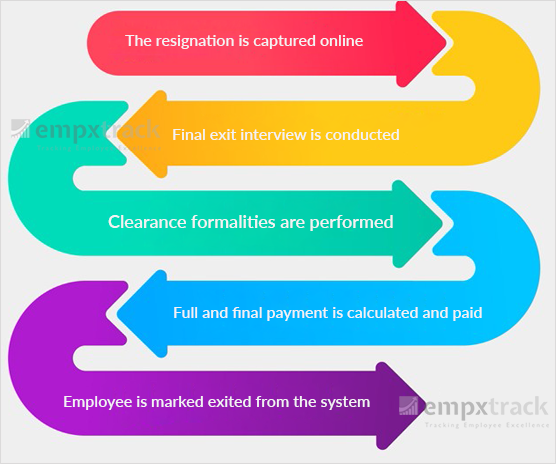
Right from the acceptance of employee resignation to approval by the manager and full & final payment by HR, automation helps streamline he employee exit management process, making it more transparent and efficient.
To complete the entire offboarding process, various approvals are needed from finance, IT, HR and other departments. With Empxtrack Exit Management tool the entire exit workflow can be carried out in a few simple steps.
Prepare Exit Checklist
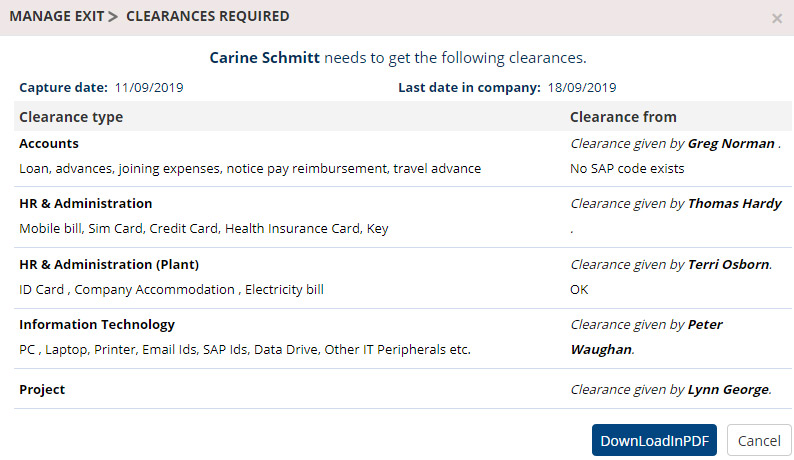
With Empxtrack exit management software, prepare department wise exit checklists in a systematic way and record checklist responses before generating full-and-final settlement and relieving letters.
A well-defined employee exit checklist helps HR teams complete exit formalities, track pending tasks, and avoid delays. Include the following steps when preparing an offboarding checklist:
- Discuss the remaining project work and its due date before an employee’s last day.
- Prepare a SOP (standard operating procedure) to set up responsibilities for the next person in the role and help him/ her excel in the position.
- Plan and complete for Knowledge Transfer (KT) to the replaced employee. Settle expenses and reimbursements for the exiting employee.
- Return company issued access cards, laptops, mobile phones, keys, etc.
- Complete departmental clearances from HR, IT, finance, and other relevant teams.
- Revoke access to company systems, applications, and confidential information where applicable.
- Complete the required exit documentation and full and final settlement.
Employee Exit Analytics
Attrition cost up to 2.5 times the salary of an employee and this is a major concern for the employers.
Tracking exit clearance and other HR exit formalities helps organizations maintain proper records and identify delays in the employee exit process.
During an employee’s lifecycle, the organization incurs expenditure on training, skill development, rewards, insurance etc.
With an exit, there is an additional cost incurred on advertising for the job role, recruiting a new person, training of the new employee and more
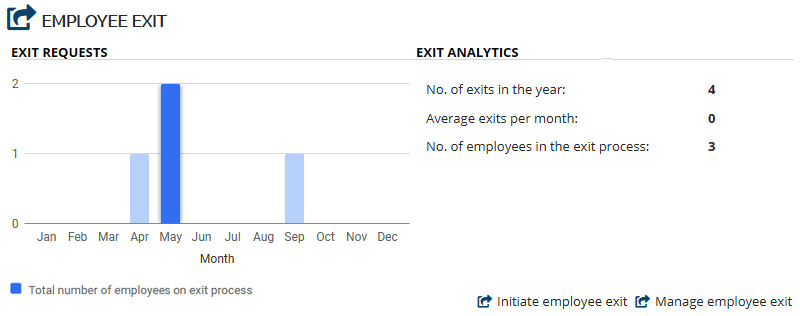
Empxtrack Exit Management tool provides exit analytics to understand employee exit reasons, identify attrition patterns, and take steps to reduce employee turnover.
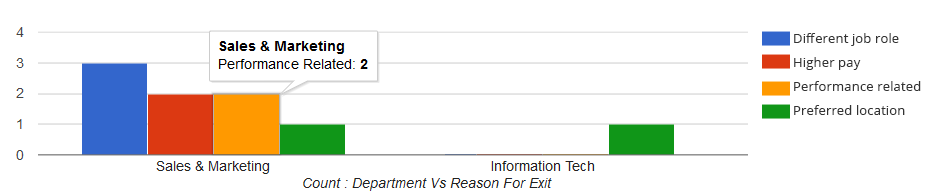
Data collected through exit analytics is helpful in increasing employee retention and organizational effectiveness. In our earlier post, we have done a thorough analysis of the employee exit reasons using 50K+ records.
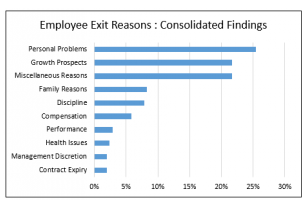
Image: The dashboard shows exit reasons with number of exited employees for each department.
Empxtrack exit analytics provides deep insights to HR, leadership and line managers in predicting and controlling attrition. Empxtrack exit data analytics helps in-
- Finding out the key exit reasons and patterns of attrition
- Gaining insights on why employees quit within a few months of joining
- Understanding the behaviour, engagement, and productivity levels of exiting employees.
- Behavior, engagement and productivity levels of the exiting employees
- Preparing a predictive model to predict future attrition
- Improving attrition rate by implementing effective retention strategies
Conclusion
With an effective exit management system, you can run analytics, analyze exit data & reasons and make a suitable action plan to combat attrition.
Empxtrack exit management tool consists of comprehensive configurable resignation workflows, knowledge transfer (KT) workflows, employee offboarding checklist workflows, online employee exit interviews and exit analytics.
An exit survey form can be invoked by HR and sent to the departing employee for gaining feedback and more insights into employee attrition. It is important to note that a formal employee exit management process mitigates security and legal threats to the employer.
Employee offboarding isn’t a permanent goodbye. Make sure to treat the exiting employee well with gratitude and leave an unforgettable milestone in their professional voyage. Try out the best exit management practices and end an employee’s journey with your organization on a good note.
Frequently Asked Questions
Q1. | What is exit management? |
| Ans. | Exit management or employee offboarding refer to the process of managing an employee’s departure from an organization. It includes resignation approvals, exit formalities, departmental clearances, knowledge transfer, asset recovery, and full and final settlement. |
Q2. | What should an employee offboarding form include? |
| Ans. | An employee offboarding form should include employee details, resignation date, last working day, handover status, company asset return, departmental clearances, pending payments, and final settlement details. HR teams can use an employee offboarding template to standardize this documentation. |
Q3. | What are the key steps in the HR exit process? |
| Ans. | The HR exit process includes accepting the resignation, obtaining manager approvals, completing knowledge transfer, recovering company assets, processing departmental clearances, and settling employee dues. Following a structured process helps HR complete employee exit formalities without delays. |
Q4. | How can organizations improve the offboarding process in HR? |
| Ans. | Organizations can improve the offboarding process in HR by automating resignation workflows, using standardized checklists, tracking exit clearance, and coordinating with HR, IT, and finance teams. A structured onboarding and offboarding process also helps maintain consistency throughout the employee lifecycle. |
Q5. | Why are exit formalities important in HR? |
| Ans. | Exit formalities in HR ensure that all required documentation, approvals, asset returns, and final payments are completed before an employee leaves. Well-managed HR exit formalities help reduce administrative delays, maintain compliance, and protect organizational information. |






The blog very well explains how employee exits can be managed systematically, leaving a good impression on the exiting employee.
All concepts of employee exit management is very well explained. The best thing is the significance of preparing exit checklist. The checklist surely helps in completing all employee exit formalities in time and giving a great experience to the leavers. Good blog!