Skip to content
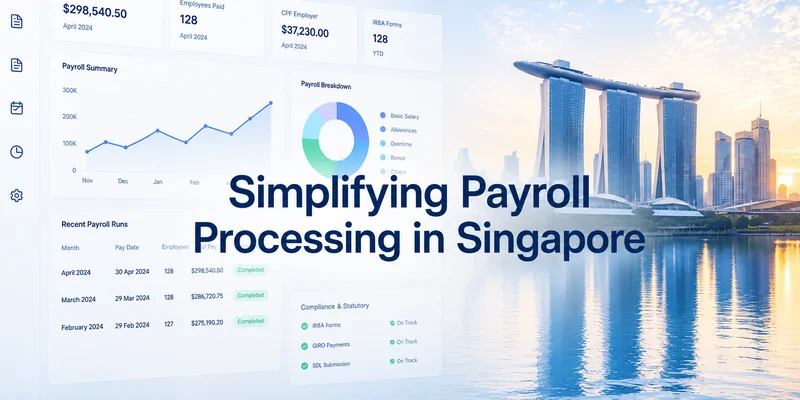
Processing payroll in Singapore involves more than just paying employees on time. Employers must ensure payroll accuracy and compliance with Singapore’s legal requirements to avoid penalties, reduce compliance risks and maintain employee satisfaction.
This article explains everything you need to know about payroll management in Singapore, including its regulations, compliance and best practices.
Table of contents
- 1. Key Payroll Legislations in Singapore
- 2. Core Components of Processing Payroll in Singapore
- 3. Statutory Contributions, Deductions, and Levies
- 4. Notice Periods & Final Settlements
- 5. Step-by-Step: How to Process Payroll in Singapore
- 6. Why Use Payroll Software to Simplify Singapore Payroll
- 7. Conclusion
- 8. Frequently Asked Questions
Key Payroll Legislations in Singapore
The Employment Act
The Employment Act outlines the key terms and conditions of employment, including salary, working hours, leave, and other workplace rights.
The CPF Act
The Central Provident Fund Act is the law that governs CPF contributions for Singapore citizens and permanent residents. It sets out the rules for CPF contributions and provides a compliance framework for CPF payments.
The Income Tax Act
The Income Tax Act 1947 is Singapore’s primary tax law, setting out the rules for how income is taxed and administered by the Inland Revenue Authority of Singapore (IRAS).
The Employment of Foreign Manpower Act
The Employment of Foreign Manpower Act, 1990 (EFMA) governs the employment of foreign workers in Singapore. It sets out the rules to obtain and manage work passes, defines the responsibilities of employers, and helps protect the rights and well-being of foreign employees.
Core Components of Processing Payroll in Singapore
Payroll Cycle, Currency & Frequency
- Employees must be paid at least once a month.
- All payments are processed in Singapore Dollars (SGD).
- Salaries must be paid within 7 days after the end of the salary period.
- Overtime should be paid within 14 days.
The deadline for an employee’s final salary payment may vary depending on the circumstances of their resignation, termination, or end of employment.
Payroll Components in Singapore
| Salary Component | Description |
|---|---|
| Basic Salary | It is the fixed amount an employee earns for regular working hours and serves as the basis for calculating CPF contributions, overtime pay, and leave pay. |
| Allowances | These are additional payments provided on top of basic salary to cover work-related expenses such as transportation, meals, housing, or communication costs. |
| Employee Benefits | These are additional employee benefits such as health insurance, life insurance, or flexible benefits. Foreign employees are not eligible for this benefit. |
| Overtime Pay | It is additional compensation provided to eligible employees who work beyond their normal working hours, at a higher rate than their regular hourly pay. |
| Deductions | These are deducted from an employee’s salary, such as CPF contributions, loan recovery, unpaid leave deductions and other deductions. |
| Variable Wage Components | a) AWS: Additional payment, commonly known as the “13th-month bonus”; applicable based on employment terms or company policy.b) Bonuses and Commissions: Variable payments that may depend on employee, sales, or company performance. |
Overtime Payroll Rules
Who is Eligible for Overtime?
- Workmen earning up to S$4,500 per month.
- Non-workmen (e.g., clerical and office employees) earning up to S$2,600 per month.
Overtime Rate Calculation
Overtime pay in Singapore is calculated as: Hourly basic rate of pay × 1.5 × Number of overtime hours worked.
Maximum Overtime Hours
According to the Employment Act in Singapore, employees can work up to 72 hours of overtime per month. Their total working time, including overtime, generally must not exceed 12 hours in a day, unless approved by the Ministry of Manpower (MOM).
Leave and Payroll
Employees covered under the Employment Act are entitled to public paid holiday if it falls on a working day. Some other leave entitlements include:
- Paid statutory leave such as maternity leave, paternity leave and childcare leave subject to applicable eligibility requirements.
- At least 7 paid annual leave which can be increased up to 14 leave annually.
- Entitlement to at least 14 days of paid outpatient sick leave and 60 days of paid hospitalization leave per year.
Minimum Wage vs Progressive Wage Model (PWM)
Singapore has not implemented a universal national minimum wage for all employees. Instead, the country uses a Progressive Wage Model (PWM), which is mandatory in specific sectors such as cleaning, security, landscape, lift and escalator maintenance, retail, food services and waste management.
Statutory Contributions, Deductions, and Levies
Central Provident Fund (CPF)
It is a mandatory monthly social security savings scheme which is funded by contributions from employers and employees.
CPF contributions are made for Singapore citizens and Singapore permanent residents (SPRs).
The following table shows in detail the current contribution rates for Singapore citizens and Singapore permanent residents.
| Employee’s Age (years) | Contribution rates from 1 January 2026 (monthly wages > $750) | ||
|---|---|---|---|
| By Employer (% of wage) | By Employee (% of wage) | Total (% of wage) | |
| 55 and below | 17 | 20 | 37 |
| Above 55 to 60 | 16 | 18 | 34 |
| Above 60 to 65 | 12.5 | 12.5 | 25 |
| Above 65 to 70 | 9 | 7.5 | 16.5 |
| Above 70 | 7.5 | 5 | 12.5 |
Note: The CPF contribution rates will rise from 1 January 2027 to strengthen retirement savings for employees aged above 55 to 65.
Mandatory Employer Levies & Deductions
- Skills Development Levy (SDL): Employers pay SDL for employees, including foreign workers, based on monthly wages and applicable minimum and maximum amounts.
- Foreign Worker Levy (FWL): This is a monthly levy imposed on employers who hire foreign workers at sector-specific rates. This applies to workers holding Work Permits and S Pass holders.
- Self-Help Group (SHG) Funds: Employers are expected to deduct SHG contributions from eligible employees’ salaries and submit them to the relevant self-help group fund.
Income Tax and Employer Reporting in Singapore
Unlike many other countries, Singapore does not require employers to withhold income tax from employee salaries. Instead, employees are responsible for filing and paying their own income tax. While employers have specific reporting obligations to IRAS.
- Form IR8A: Reports employee remuneration and is submitted through the Auto-Inclusion Scheme (AIS) where applicable.
- Appendix 8A: This is required for employees who receive applicable taxable benefits in kind.
- Appendix 8B: Employers need to use this when employees derive gains from employee stock option (ESOP) plans and other employee share ownership (ESOW) schemes.
- Form IR21 (Tax Clearance): If a foreign employee or Singapore Permanent Resident (SPR) is leaving Singapore or leaving their job, the employer may need to file Form IR21 with IRAS.
Notice Periods & Final Settlements
A Notice period refers to the advance notice that either the employer or the employee must provide to end the employment relationship.
The full and final settlement includes salary earned up to the employee’s last working day, along with the encashment of accrued but unused annual leave, where applicable.
- If an employee is terminated without serving notice, the employer generally pays salary in lieu of notice.
- Employees can be terminated without notice only in cases of proven misconduct such as willful disobedience, repeated unauthorized absence or criminal offences.
Step-by-Step: How to Process Payroll in Singapore

- Establish the Pay Base: Determine the employee’s gross monthly salary, including basic salary, fixed allowances, and other recurring payments. Identify if the employee is a Singapore Citizen, Permanent Resident, or Foreign Employee.
- Calculate Variable Components & Overtime: Add all variable earnings for the payroll period, such as bonuses, commissions, incentives, shift allowances, and overtime pay.
- Apply Payroll Deductions: Deduct employee contributions and authorized deductions where applicable.
- Compute Employer Liabilities: Calculate CPF contributions, Skills Development Levy (SDL), and any applicable Foreign Worker Levy for eligible Work Permit and S Pass holders.
- Calculate Net Pay: Determine the employee’s net pay after all earnings, deductions, and adjustments have been applied.
- Disburse Salary & Issue Payslips: Pay employees within the required timeline and issue payslips.
- Complete Statutory Filing & Payments: Employers should ensure timely CPF submissions and other statutory filings within the prescribed deadlines, AIS reporting where required.
Requirements for Payroll Record Keeping In Singapore
Employers must maintain a detailed record of employment and salary records for employees covered under the Employment Act. These records include:
- Employee identification and employment details
- Basic salary, allowances, deductions, overtime, and net pay
- Hours worked and overtime records
- Leave and public holiday records
- CPF contributions
- Date of employment termination
Note: The employer must retain these records for at least 2 years for current employees and 1 year after an employee leaves the company.
Why Use Payroll Software to Simplify Singapore Payroll
It is crucial for employers to calculate payroll accurately every time. They must also meet statutory requirements such as CPF contributions, SDL, and IRAS reporting.
A reliable payroll system for Singapore, such as Empxtrack, can simplify payroll processing by automating key calculations, validations, and reporting tasks.

- Automate salary calculations: Process basic salary, earnings, deductions, overtime, bonuses, and allowances.
- Calculate contributions: Accurately calculate CPF and SDL contributions based on applicable payroll rules.
- Itemized payslip: Generate itemised payslips and maintain payroll records.
- IRAS reporting: Generate AIS and year-end tax reporting.
- Employee self-service: Provide access to payslips and payroll information.
- Minimize compliance risks: Reduce administrative workload and help avoid compliance penalties.
- HR modules integration: Integrate attendance and leave data with payroll to reduce manual processing.
- Payroll transparency: Improve payroll visibility with real-time reporting and dashboards.
Conclusion
Managing payroll in Singapore requires employers to maintain accurate calculations, meet statutory requirements, and keep up with changing payroll regulations.
Organizations evaluating a cloud-based payroll software provider in Singapore should choose a payroll solution that can automate CPF calculations, statutory reporting, employee record management and other key payroll processes. By shifting to global software platforms such as Empxtrack, organizations can improve payroll accuracy, reduce administrative effort. This also helps ensure timely salary processing, strengthen employee trust, and ensure compliance.
Frequently Asked Questions
Q1. | What are the main steps involved in processing payroll in Singapore? |
| Ans. | Main steps involved in processing payroll in Singapore include: 1. Establishing the base pay 2. Calculating variable components & overtime 3. Applying payroll deductions 4. Computing employer liabilities 5. Calculating net pay 6. Disbursing salary & issuing payslips 7. Completing statutory filing & payments |
Q2. | Are Annual Wage Supplement (AWS) and bonuses subject to CPF contributions? |
| Ans. | Yes, annual Wage Supplement (AWS), bonuses, commissions, and other additional wages are generally subject to CPF contributions, provided they are paid to employees who are eligible for CPF contributions. |
Q3. | What payroll records must employers maintain in Singapore? |
| Ans. | Employers must maintain payroll records such as employee particulars, salary details, working hours, overtime records, leave records, CPF contributions, and employment termination details. These records must be kept for 2 years for current employees and 1 year after an employee leaves. |
Q4. | Is CPF mandatory for all employees? |
| Ans. | CPF contributions are mandatory for Singapore Citizens and Permanent Residents who are employed under a contract of service. Foreign employees holding Employment Passes, S Passes, or Work Permits are generally not subject to CPF contributions. |
Q5. | Do part-time employees in Singapore have the same CPF and leave entitlements as full-time employees? |
| Ans. | Yes, part-time employees are generally entitled to the same CPF contributions and leave benefits as full-time employees. However, their leave entitlements are calculated according to their working hours and employment terms. |
Q6. | What happens to an employee’s unused annual leave upon resignation or termination in Singapore? |
| Ans. | When an employee leaves upon resignation or termination in Singapore, they are entitled to payment for any accrued but unused annual leave. This is calculated on a pro-rated basis up to their last completed month of service. |
Q7. | How can a payroll software help businesses manage CPF, AIS reporting, and compliance in Singapore? |
| Ans. | Payroll software helps businesses manage Singapore payroll compliance by automating statutory calculations, reducing manual errors, and ensuring timely submissions. The software can calculate CPF contributions, manage SDL and other payroll deductions, generate reports, maintain employee records and support AIS reporting for IRAS. |
Q8. | Which is the best payroll software in Singapore? |
| Ans. | The best payroll software in Singapore should automate salary calculations, CPF contributions, SDL deductions, payslips, reporting, and compliance tasks. Empxtrack helps businesses simplify payroll processing, reduce manual effort, and manage employee payroll data in one centralized platform. |
Looking for more answers? Visit our Singapore Payroll FAQs.