Skip to content
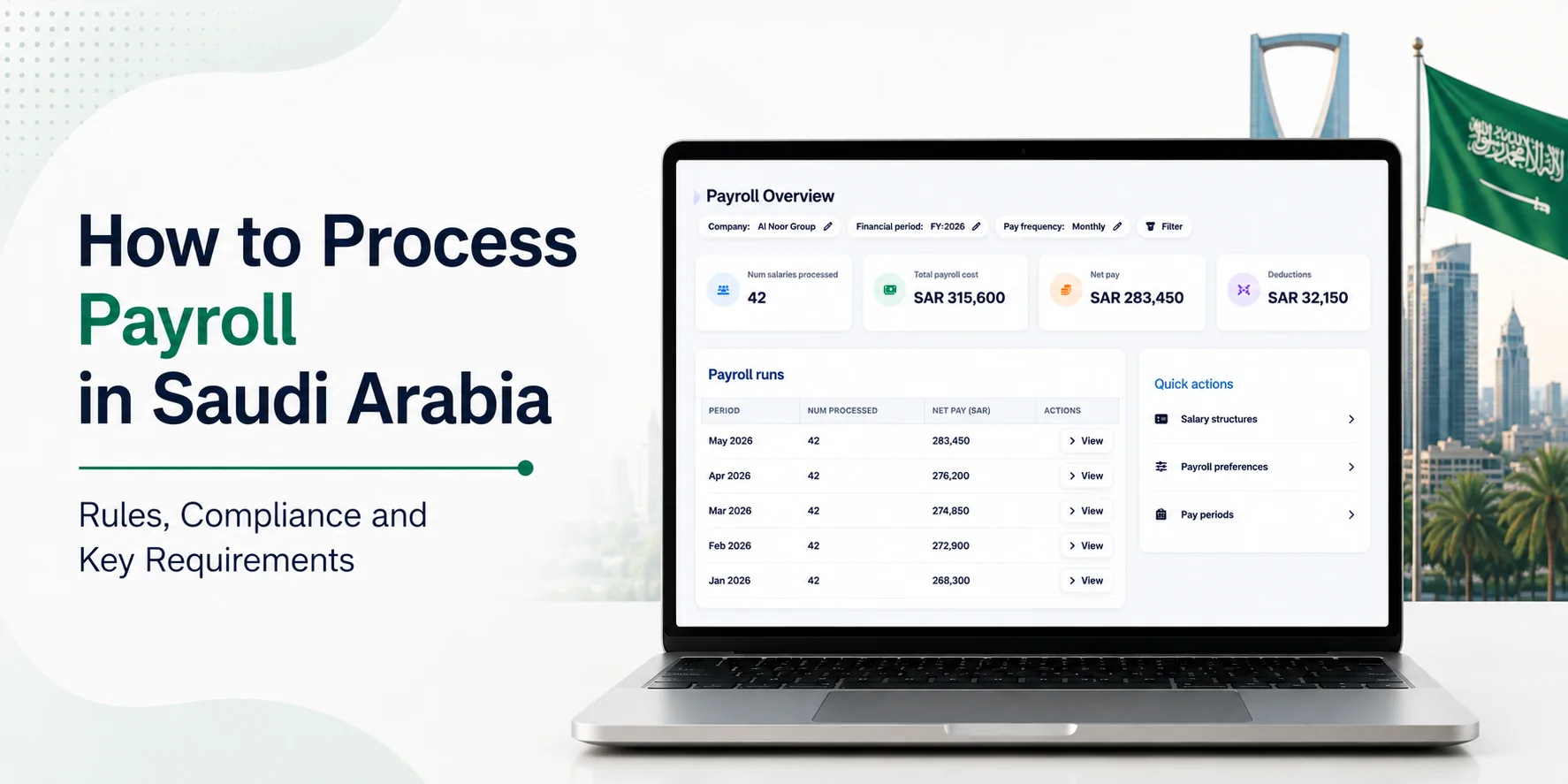
Saudi Arabia is rapidly undergoing business transformation, making payroll processing in Saudi Arabia increasingly important for growing businesses. Vision 2030 is driving economic growth, workforce expansion, and digitalization, and also reshaping how employers manage payroll.
Employers are paying greater attention in managing GOSI contributions, Qiwa contract records, Mudad submissions, WPS compliance, leave and attendance inputs, and final settlement calculations.
In this article, we will discuss key labor law, regulatory requirements and best payroll practices that employers need to know.
Table of Contents
- 1. Employment Framework for Payroll Processing in Saudi Arabia
- 2. Payroll Cycle, Currency, and Salary Payments
- 3. Components of Employee Compensation in Saudi Arabia
- 4. Social Insurance Contributions (GOSI) & Payroll Tax in Saudi Arabia
- 5. Leave, End-of-Service Benefits (EOSB) and Final Settlements
- 6. Payroll Processing in Saudi Arabia: Step-by-Step
- 7. How Empxtrack Handles Payroll Processing in Saudi Arabia
- 8. Conclusion
- 9. Frequently Asked Questions
Employment Framework for Payroll Processing in Saudi Arabia
Saudi Labor Law
The Saudi Labor Law issued under Royal Decree No. M/51 forms the legal foundation of payroll processing in Saudi Arabia and is supported by various regulatory bodies. The law defines key employment requirements related to employment contracts, working hours, wages, leave, termination, and end-of-service benefits.
Key Regulatory Authorities
- MHRSD: Ministry of Human Resources and Social Development, which oversees employment policies and work related compliance.
- GOSI: General Organisation for Social Insurance, which manages pensions, social insurance contributions and occupational hazards.
- Qiwa: Supports digital employment contracts and workforce-related employment services.
- Mudad: Supports wage protection file submission and payroll compliance monitoring.
- ZATCA: Zakat, Tax and Customs Authority is relevant for tax and zakat-related obligations that may affect business compliance.
Employee Categories Covered by Payroll Rules
- Saudi Nationals: Covered by GOSI contributions and Saudization (Nitaqat) requirements in addition to standard KSA payroll regulations.
- Expatriate Workers: Covered by payroll regulations linked to valid employment contracts, work permits (Iqamas), and applicable labour law requirements.
Onboarding Documentation & The 180-Day Probation Rule
Employee onboarding in Saudi Arabia includes employment contract signing, Qiwa attestation, GOSI registration, Iqama processing (for expatriate employees), and payroll setup.
Under the Saudi Labor Law, the probation period cannot exceed 90 days, though it can be extended up to 180 days if both the employer and the employee give their written consent.
Payroll Cycle, Currency, and Salary Payments
The Saudi Riyal (SAR) is the official currency of the Kingdom of Saudi Arabia. The payment frequency depends on the type of work. For instance, under Saudi Arabia’s Wage Protection System (WPS), employers must pay salaried employees once a month, while daily-paid employees must be paid weekly. Piece-rate workers must also receive weekly payments based on the work completed, with any remaining balance paid after delivery.
Failing to pay on time can trigger reminders and notifications via the Mudad platform starting on the 10th day of the following month.
Salary Payment Methods
Salaries must be paid through bank transfers via the Wage Protection System (WPS), authorized payroll cards, or approved digital payment channels such as Mudad, STC Pay, and Urpay for eligible worker categories. While cash payments are completely illegal for standard corporate employees.
Components of Employee Compensation in Saudi Arabia
| Payroll Component | Description |
|---|---|
| Basic Salary | This is the fixed salary paid for an employee’s regular working hours, which serves as the basis for calculating overtime, annual leave pay, and other payroll-related payments. |
| Housing Allowance | It can be provided as a fixed allowance or company housing and is generally considered when determining an employee’s GOSI-contributory salary. |
| Transportation Allowance | A fixed monthly payment provided to help cover commuting expenses and is generally not included in GOSI contribution calculations. |
| Fixed and Variable Allowances | Fixed allowances are paid regularly at a set amount, while variable allowances may change depending on factors such as performance, travel, shift work, or special assignments. |
| Commissions and Incentives | Additional earnings awarded based on sales performance, targets achieved, or other performance metrics. Saudi Arabia does not mandate a 13th-month salary or bonus. |
| Overtime Pay | Extra compensation for hours worked beyond regular working hours. |
Working Hours and Overtime Rules
Standard Working Hours
- 48 hours per week is the standard maximum working hours.
- 8 hours per day is generally worked over 6 days.
- 11 hours per day is the maximum workplace presence, including rest periods.
- During Ramadan, working hours for Muslim employees are reduced to 6 hours per day or 36 hours per week.
To protect workers from heat-related risks, employers are prohibited from requiring employees to work outdoors under direct sunlight between 12:00 PM and 3:00 PM, from 15 June to 15 September. Each year, subject to MHRSD’s annual implementation announcement.
Overtime Eligibility
Employees are generally eligible for overtime pay when they work beyond the standard working hours or on official holidays and weekly rest days.
Overtime Calculation Formula
Overtime pay in Saudi Arabia is calculated at 150% of the employee’s regular hourly wage (an additional 50% of the basic wage for each overtime hour).
Compensatory Leave
Work on a weekly rest day or official holiday may be compensated with a compensatory leave or overtime pay, where it is permitted.
Social Insurance Contributions (GOSI) & Payroll Tax in Saudi Arabia
The General Organization for Social Insurance (GOSI) administers social insurance contributions in Saudi Arabia. Employers must register eligible employees, calculate and pay monthly contributions, and update GOSI records for salary or employment changes.
GOSI Contribution Rates (2026)
Saudi Arabia operates two GOSI contribution systems for Saudi employees, based on their GOSI registration date.
| GOSI Registration Date | Total Contribution Rate | Contribution Split |
|---|---|---|
| Before 3 July 2024 | 21.5% of wages | 11.75% employer contribution 9.75% employee contribution |
| On or after 3 July 2024, effective from 1 July 2026 | 23.5% | 12.75% employer contribution 10.75% employee contribution |
Occupational Hazard Contributions
Employers are required to contribute 2% of the employee’s contributory wage toward occupational hazards insurance for both Saudi and expat employees. This is subject to a maximum contribution wage of SAR 45,000 per month.
Payroll Tax Considerations in Saudi Arabia
Saudi Arabia does not impose personal income tax on employee salaries. However, withholding tax may apply to certain payments made to non-resident entities, with rates generally ranging from 5% to 20% depending on the nature of the payment. Expatriate employees may also remain subject to tax filing or reporting obligations in their home country, depending on its tax laws and residency rules.
Leave, End-of-Service Benefits (EOSB) and Final Settlements
Employers must account for different paid and unpaid leave types, as they affect salary calculations, deductions, and final settlements. Key payroll considerations include:
- Annual leave and unused leave balances
- Sick leave at full, partial, or no pay
- Paid statutory leave such as maternity, paternity, marriage, and bereavement leave
- Hajj and study leave where applicable
- Unpaid leave and its impact on salary deductions
- Leave encashment during final settlement
End-of-Service Benefits (EOSB)
These are payments made to employees at the end of their employment, based on their length of service and the terms of Saudi Labor Law.
EOSB is generally calculated based on an employee’s last wage, total length of service, and the reason for leaving. Employees are entitled to half a month’s wage for each of the first five years of service and one month’s wage for each additional year. Partial years are calculated on a pro-rata basis.
Example
An employee with a monthly wage of SAR 10,000 and 8 years and 3 months of service would receive:
- First 5 years: 5 × 0.5 × 10,000 = SAR 25,000
- Next 3 years: 3 × 10,000 = SAR 30,000
- Additional 3 months: 3/12 × 10,000 = SAR 2,500
Total EOSB = SAR 57,500
Resignation vs. Termination Rules
| Type | Length of Service | EOSB Entitlement |
|---|---|---|
| Resignation (Article 85) | Less than 2 years | No EOSB entitlement |
| 2 to 5 years | One-third of the calculated EOSB | |
| More than 5 years and less than 10 years | Two-thirds of the calculated EOSB | |
| 10 or more years | Full EOSB entitlement | |
| Termination by the Employer | Any length of service | Employees are generally entitled to the full EOSB calculated under Saudi Labor Law, unless the termination falls under circumstances where benefits may be forfeited. |
Cases Where EOSB May Be Reduced or Forfeited
EOSB may be reduced when an employee resigns before reaching certain service milestones or forfeited in cases of serious misconduct covered under Article 80. These cases include assault, dishonesty, forgery, disclosure of trade secrets, misuse of position, or prolonged unexcused absence.
Notice Periods and Final Settlements
For indefinite-term contracts, employers must give 60 days’ written notice, while employees must give 30 days’ notice. Failure to serve notice requires compensation for the unserved notice period.
EOSB Settlement Requirements: Employers must settle all employee dues, including EOSB and other outstanding entitlements, within one week of employer-initiated termination or within 2 weeks of the employee’s departure from the organization.
Payroll Processing in Saudi Arabia: Step-by-Step

Payroll processing becomes easier when each activity is handled in the right sequence.
| Step | Process |
|---|---|
| Step 1 | Gather Employee Payroll Data Collect attendance records, approved leave, overtime hours, commissions, and employee updates such as new hires or resignations. |
| Step 2 | Calculate Earnings and Deductions Calculate gross earnings, including basic salary, allowances, commissions, and overtime, then apply GOSI contributions and any authorized deductions to determine net pay. |
| Step 3 | Calculate Employer Contributions Calculate employer GOSI contributions and occupational hazard insurance contributions, where applicable. |
| Step 4 | Process Salary Payments Transfer salaries through approved banking channels and ensure compliance with Wage Protection System (WPS) requirements. |
| Step 5 | Generate Payslips Issue payslips showing earnings, deductions, and net pay. |
| Step 6 | Complete Statutory Reporting Update employee records and submit required payroll information through platforms such as GOSI, Qiwa, and WPS-related systems. |
How Empxtrack Handles Payroll Processing in Saudi Arabia
Managing payroll in Saudi Arabia requires accurate salary calculations, timely payments, GOSI contributions, WPS compliance, and proper handling of employee records. As organizations grow, manual payroll processes can increase the risk of errors, delays, and compliance gaps.
A reliable payroll management system such as Empxtrack helps reduce manual errors and simplify payroll processing in Saudi Arabia.

- Salary calculations for both Saudi nationals and expatriates
- GOSI contribution calculation including employer and employee contributions
- WPS-ready payroll data
- Employee self-service access for payslips, attendance, leave balance and payroll information
- Payslip generation with earnings, deductions and net salary details
- Final settlement input and records for ESOB, unused leave and other outstanding dues
Conclusion
A reliable payroll process helps Saudi businesses pay employees accurately, meet GOSI and WPS requirements, and keep payroll records aligned across Mudad, Qiwa, and GOSI.
As payroll requirements evolve, using a payroll processing software in Saudi Arabia can help reduce administrative effort, improve payroll control, and support ever-evolving compliance requirements. Businesses can start with Empxtrack’s free payroll offering and use the platform to explore core payroll and HR features.
Frequently Asked Questions
Q1. | Is there a personal income tax on salaries in Saudi Arabia? |
| Ans. | No. There is zero personal income tax on salaries in Saudi Arabia. Both local Saudi employees and expatriates (foreign workers) keep 100% of their earnings without any tax being deducted. |
Q2. | How is the End-of-Service Benefit (EOSB) calculated in KSA? |
| Ans. | EOSB is a mandatory cash payout given to workers when their employment ends. It is based on the employee’s last wage. First 5 years of service: You get 15 days’ (half a month) worth of salary for each year worked. After 5 years of service: You get 30 days’ (one full month) worth of salary for each year worked. Note: If you resign voluntarily before hitting 2 years of service, you get nothing. If you resign between 2 to 5 years, you only get 1/3 of the amount. |
Q3. | What are the GOSI social insurance rates in 2026? |
| Ans. | GOSI is the mandatory social insurance system. The rates depend on nationality: Expatriates: The employer pays a flat 2% for workplace injury insurance; the employee pays 0%. Saudi Nationals (Legacy – joined before July 2024): Total 21.5% (Employer pays 11.75%, Employee pays 9.75%). Saudi Nationals (New – joined after July 2024): In 2026, the rate is 22.5% (Employer pays 12.25%, Employee pays 10.25%). This has risen by 1% on July 1, 2026. |
Q4. | Do expatriate employees in Saudi Arabia get GOSI coverage? |
| Ans. | Yes, expatriate employees are covered by GOSI, but only for Occupational Hazards Insurance. Unlike Saudi nationals, expatriates are not covered for pension or SANED (unemployment) benefits. Employers must contribute 2% of the expatriate employee’s contributory wage toward occupational hazards insurance, while expatriate employees do not make GOSI contributions. |
Q5. | What is Saudization (Nitaqat) and how does it affect payroll? |
| Ans. | Saudization (Nitaqat) is Saudi Arabia’s workforce localization program that requires private-sector businesses to employ a minimum percentage of Saudi nationals. Accurate payroll and employee records are crucial, as data submitted through GOSI, Qiwa, and WPS is used to monitor compliance with Nitaqat requirements. |
Q6. | What payroll records must employers maintain in Saudi Arabia? |
| Ans. | Employers should maintain accurate records of employee salaries, allowances, overtime, deductions, GOSI contributions, leave, and payroll payments to support compliance, reporting, and audits. Empxtrack helps businesses maintain these payroll records securely in a single, secure centralized system. Thus, making it easier to access employee information, generate reports, and stay prepared for regulatory reviews. |
Q7. | How are part-time or piece-rate workers paid under Saudi Labour Law? |
| Ans. | Part-time employees are paid based on their agreed working hours or wages. On the other hand, piece-rate workers are paid according to the work completed. If a piece-rate job takes more than two weeks to complete, the employee must receive weekly payments for the work completed, with the remaining amount paid within the following week after the work is delivered. |
Looking for more answers? Visit our Saudi Arabia Payroll FAQs.