Skip to content

This blog highlights the reasons why performance appraisals fail. It also encourages you to use the best HR practices to make evaluations more meaningful.
Annual performance assessments are carried out to evaluate yearly performance of employees. Through annual appraisals, managers evaluate employee performance and their overall contribution to the company.
A well-structured and effective evaluation process allows managers to clearly and accurately identify top, average and low performers. In the long run, this also helps in properly rewarding, training and mentoring employees accordingly.
However, at times, managers delay employee assessment by failing to provide timely feedback. This, in turn, causes great dissatisfaction among the employees. And due to this, they often feel undervalued and confused about their performance, which negatively impacts their productivity. Therefore, it is crucial to find out the reasons why performance appraisals don’t work.
Managers often ask this question – What are the problems with performance appraisals?
Let’s try to find out.
» Sometimes, the existing performance review process is ineffective.
» Some managers treat appraisal meetings as one-way conversations.
» Reviews often focus on forced rankings instead of employee development.
Thus, the first thing that HR, managers and leaders need to identify is the weak points and inefficiencies in annual performance assessments.
So now the question arises – Do employees really feel engaged and motivated with annual performance appraisals? Surprisingly, the answer is Yes!
Employees feel excited about their performance evaluations only when the process is fair and focuses on their skill development. When feedback is constructive, transparent, and tied to clear growth opportunities, employees are more engaged and motivated to improve.
Now, here is a list of the most common problems that lead to annual appraisals’ failure.
Why Performance Appraisals Fail? Explore What are the Problems with Performance Appraisals
There could be many reasons for appraisal failure. As a matter of fact, it is important to remember that employee evaluations are done not only to provide useful feedback. But also to develop better working relationships.
Now, let’s discuss the drawbacks first. 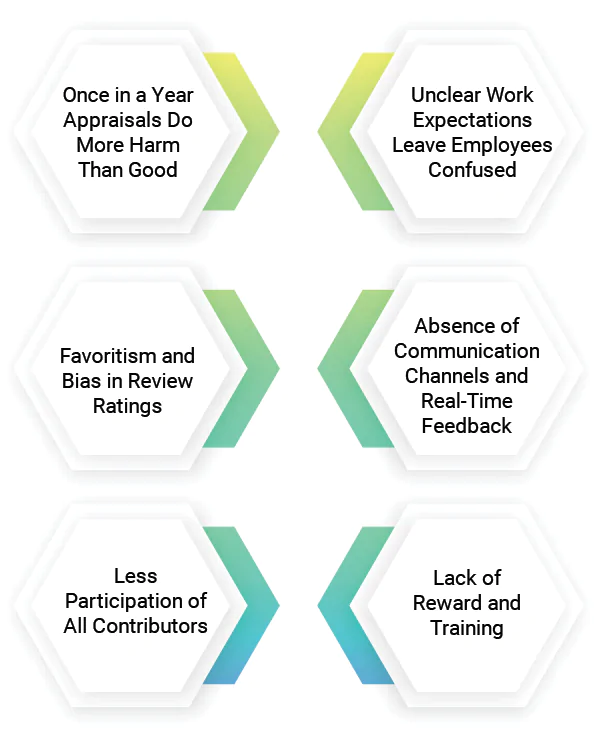

Once in a Year Appraisals Do More Harm Than Good
Employees do not feel satisfied with once in a year evaluations. They expect their managers to guide them from time to time.
Managers, on the other hand, do not have frequent performance conversations with their subordinates. Thus, employees remain unaware of missed deadlines and unachieved goals as a result.
Unclear Work Expectations Leave Employees Confused
In many organizations, employee goals are overlooked, even though setting clear work expectations for a balanced appraisal is essential. However, many employers fail to put this into practice. They keep their eyes only on key result areas and job responsibilities. This results in ineffective appraisal decision making.
Also, the absence of positive, real-time feedback reduces the accuracy of the review process.
Favoritism and Bias in Review Ratings
According to research, two-thirds of performance management systems, regardless of forced rankings, misidentify top performers.
It is a fact that employees expect a fair review process at their workplace. The evaluations should be free from any bias by all means. Manager feedback needs to be based on performance reports or employee achievements.
Instead, multiple types of biases are found at the workplace. For instance, recency bias, leniency and severity bias, racial and gender bias, negativity bias and more.
Employees ultimately feel unhappy about bias, irregular feedback and personal opinions.
It must be remembered that managers should not pass personal opinions or judgments on employee behavior. Instead, they should evaluate employee work achievements. Otherwise, managers miss out on leaving a good impression on the team.
Absence of Communication Channels and Real-Time Feedback
Employees often complain that their managers do not openly discuss performance issues. In the absence of communication, usually the appraisals tend to be ineffective. This is one of the major reasons why performance appraisals fail.
Employee dissatisfaction increases under these circumstances. Thus, it is equally important to give feedback and discuss employee productivity and quality of work.
Employees, on the other hand, struggle to identify their career path due to limited communication and insufficient feedback from managers, which ultimately weakens employee–manager relationships. Employees are unable to take the next step towards achieving their career goals. Thus, it causes harm to employees as well as the employer.
Less Participation of All Contributors
A very common reason why performance appraisals don’t work is due to the non-participation and involvement of all the stakeholders. These include HR, managers, reviewers, employees, and more.
A shortage of stakeholder reviews can lead to inconsistency and unfairness in the appraisal process. Feedback from multiple stakeholders can provide additional strengths and areas for improvement. In fact, they can help catch any potential biases or inconsistencies stemming from the sole manager’s reviews.
A wider range of stakeholders and contributors can help create a more robust, accurate, and effective performance management system.
Lack of Reward and Training
Old way of performance appraisals only encouraged top-to-bottom evaluation. Subordinate feedback and employee self-assessment are given less (or no) importance in such a situation. As a result, managers are unable to decide the performance of individuals. Besides, employees are never rewarded or coached during the review process.
Lengthy Appraisal Forms
Long forms with too many questions are bewildering for employees and equally annoying to managers as they have to complete them for each team member. Additionally, lengthy evaluation forms make it difficult for organizations to conduct performance reviews multiple times throughout the year.
Instead, an effective appraisal form should focus on a small set of useful questions that clearly indicate whether the employee is performing well or needs improvement.
Feedback Without Follow Up
A common challenge for most employees is feedback without follow-up. When reviews end without clear actions or visible changes, the process feels meaningless rather than constructive. Therefore, performance reviews need to be effective in such a way that it leads to concrete next steps and measurable progress, not just a conversation.
How to Make Performance Appraisals Effective?
A successful performance appraisal creates goals, lists employee achievements, prepares a development plan, engages employees among other things. Although planning and carrying out employee assessment is a tough task. However, it is not impossible.

It is advised to use reliable performance assessment software. Firstly set SMART goals, then share ongoing feedback, measure day-to-day performance, identify the scope of improvement and retain top talent. With an employee evaluation software, you can continuously monitor employee achievements as well as identify top performers. In addition, you can easily include all stakeholders in the evaluation.
The use of online evaluation software allows for more accurate and timely decision making. It also helps to:
» Set clear work expectations for all employees.
» Give positive feedback regularly and help employees if they are having problems.
» Identify and reward top performers and keep them motivated.
» Provide training to employees and create skill development plans.
» Prepare potential leaders to create a succession pipeline.
» Lead a transparent review process. Let employees feel satisfied and complete their reviews without delay.
» Improve employee motivation and engagement by linking performance to pay.
Conclusion
There are many benefits of a systematic performance evaluation process. It is a formal practice carried out for all employees to analyze their contribution and performance. Though some companies make the most of the evaluation process, whereas others fail to do so. They are unable to identify what are the problems with performance appraisals.
There could be several reasons why performance appraisals don’t work. Unclear goals, infrequent feedbacks, manager bias, poor training and focus on single event rather than continuous development. However, with the right approach, performance evaluations can be both effective and rewarding for the employees.
Therefore, it is equally important for an employer to carry out reviews that are purposeful as well as employee-centric. Most importantly, you should set clear SMART goals and hold performance conversation sessions frequently, and not just once a year. Instead, use employee evaluations to improve employee development and increase engagement and retention.
If you have a lot of employee issues regarding annual performance appraisals, then make sure you use reliable appraisal software! Don’t just spend time wondering why performance appraisals fail. Before it’s too late, you should identify the weaknesses in your evaluation process and take action.
Frequently Asked Questions
Q1. | What are the steps in an effective performance evaluation? |
| Ans. | Steps in a fair and effective performance assessment vary depending upon the nature of work. Make sure you know why performance appraisals fail and don’t repeat those mistakes. A simple approach can be used for the majority of white-collar employees: ● Define a performance period and set up clear goals for employees ● Decide how many stakeholders will participate in the evaluation. Ideally, the employee, manager, reviewer, and HR professionals should be involved ● Allow managers to make performance notes at regular intervals ● Start the performance assessment with the employee’s self-evaluation ● Include feedback from managers, peers, and colleagues using a 360 feedback system ● Provide fair ratings and conduct the final review meeting as a two-way conversation ● Carry out regular follow-ups to keep employees motivated and track progress Additionally, using an online performance assessment software can help simplify the process and improve outcomes. |
Q2. | Does any employee evaluation software allow self appraisal? Why do performance appraisals fail without employee self evaluation? |
| Ans. | Employees often feel disengaged when they have no say in their appraisal process. With performance evaluation software like Empxtrack, employees can actively participate and: ● Identify their strengths and weaknesses ● Suggest improvements in company processes ● Share challenges they face at work Employee self-evaluation motivates individuals to reflect on their performance and take ownership of their goals. It also makes the appraisal process more fair, transparent, and meaningful. |
Q3. | How many times should I have a performance conversation with my subordinates in order to keep them motivated? What will be your suggestions for a first time manager? |
| Ans. | The first time manager is suggested to find out the needs of their team members. Talk to your subordinates as regularly as possible. Managers must ask about the problems faced by employees in achieving goals. However, a manager should carry out performance conversation twice or thrice in a performance period. Real-time feedback is the most important thing. It helps employees to perform better and meet their goals in time. |
Q4. | Why is it important to carry out holistic appraisals? |
| Ans. | A performance appraisal is carried out to improve employee’s overall efficiency and performance. Ensure that employees are performing best of their abilities and their skill development plans are taken care of. It is critical to conduct holistic appraisals in order to win the trust of employees. When they are motivated and engaged, the team’s overall productivity rises, which leads to a higher level of performance. |
Q5. | Can performance appraisal software help reduce appraisal failures? |
| Ans. | A performance appraisal software streamlines the performance review process, which boosts employee engagement and helps in employee development. The software addresses issues associated with manual review processes, such as inconsistency and infrequent feedback. |
Q6. | What makes a performance appraisal successful? |
| Ans. | A performance appraisal is successful when it is fair, transparent, and focused on growth, rather than just ratings. In addition, clear goals, continuous feedback, and a two way conversation help employees understand their expectations better. Moreover, incorporating reviews from multiple stakeholders also makes the process more meaningful. |